If you saw an ad for ZeroWattic, you saw a plug, a glowing light and a promise that your electric bill is about to drop. Underneath the branding, it belongs to a long-running family of plug-in "power saver" gadgets sold on roughly the same pitch. This page isn't a recommendation or a warning — it's a plain description of how the product is sold, what its pages claim, how this kind of device behaves on a home circuit, and what we'd want answered first. Everything below reflects pages we opened on November 3, 2026, plus published references you can check yourself.
What it is and how it's sold
ZeroWattic is marketed as a compact unit — the images show a white enclosure with a small green indicator strip — that you plug in and leave in place. The marketing frames it around "power quality": phrases such as improving the way electricity is handled and reducing wasted energy appear across its pages, usually beside a softer line that actual savings may vary and should not be assumed in advance.
There is no single official shop. The name is spread across a rotating set of pre-sell pages — free-hosted site-builder pages, order forms, and "sponsored" articles on newswire and local-newspaper domains — all funnelling clicks to checkout storefronts (one order flow we followed pointed at a general retail-style domain, not a manufacturer site). Prices shift by campaign: one review of the seller's own page reported a single unit at about $49, from $98, with a 60-day money-back guarantee and cheaper multi-unit bundles. Several pages show a "4.8 out of 5" rating with no source. We cite those domains as plain text, not links, and don't present ZeroWattic's price as a figure to rely on, since it changes page to page.
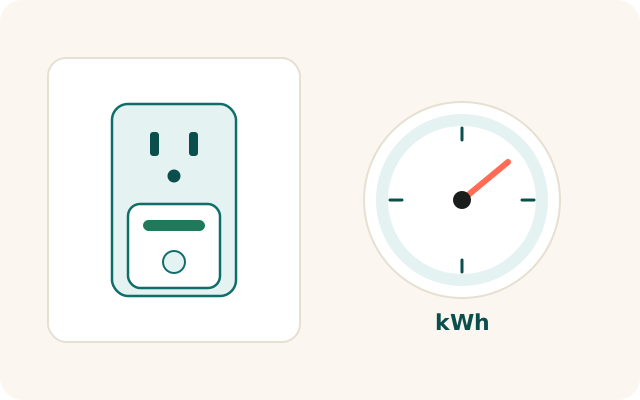
How the device is presented: a plug-in unit with a status light. Home meters, though, bill in kilowatt-hours.
What the spec sheet actually says
The "spec sheet" is mostly adjectives: across the pages using the ZeroWattic name we found marketing language and almost no engineering. Here is what's claimed, each line marked for what it is.
| What the pages say | Status |
|---|---|
| "Stabilizes" electrical current and "improves power quality" | Seller claim, not independently tested |
| Reduces "wasted" or "dirty" electricity in the wiring | Seller claim, not independently tested |
| Performs reactive-power / power-factor correction | Describes a real engineering function (see below) |
| Helps lower overall household energy use | Seller claim; no measurement method shown |
| Voltage, frequency, wattage, internal components | Not disclosed on any page we opened |
| Independent lab testing or a safety mark | None found |
Different pages hedge differently — some lean into the savings language, others add a disclaimer that savings "should not be assumed." When the same product is described two ways depending on which ad sent you, treat the stronger version as advertising, not specification.
How this class of device actually works
Strip away the branding and the mechanism the marketing describes — "reactive power compensation," "stabilizing current," "absorbing" electrical noise — points to a small power-factor-correction capacitor: a real, well-understood piece of electrical engineering. Power factor is the gap between the apparent power a load pulls from the grid and the real power it converts into work; motors and other "inductive" loads draw reactive current that does no useful work, and a correction capacitor can offset some of it.
The catch is who gets billed for reactive power. Large industrial sites running heavy motors often are billed for poor power factor, so correction equipment can genuinely save them money. A typical US household is not: residential meters almost universally record and bill real power, in kilowatt-hours (kWh) — the energy your lights, fridge and electronics actually consume — and ignore the reactive component this kind of device targets. So even if a plug-in unit shifts power factor exactly as advertised, the quantity your utility charges you for is usually untouched. That's a point about home billing and this category of gadget, not a teardown of one unit.
Facts worth checking before you buy
None of the following proves ZeroWattic does nothing. They're the gaps we'd want closed before spending, each stated plainly.
- No named company. We found no manufacturer, LLC or registered business standing behind the product on the pages themselves. The contact details on one storefront were a support address on an unrelated-sounding retail domain, a toll-free number, and a Miami mailing address of the "suite + number" form that typically denotes a mailbox service rather than a factory or office.
- No independent testing. Every performance statement traces back to the seller. We located no non-manufacturer measurement of energy saved.
- "Approved to work in all 50 states." This phrase recurs in the category without naming an approving body. US electrical devices normally carry a recognized safety mark such as UL or ETL; none is cited, so it's unclear what "approved" means here.
- Urgency and testimonial patterns. Pages in this category commonly show a countdown that claims the discount "expires at midnight" yet resets to the same message on every reload, and testimonials quoting exact dollar savings ("saved $35 a month") with no description of how the figure was measured. Treat both as sales devices.
- Many near-identical twins. The same photos, claims and page template appear under a parade of other names (StopWatt, EcoWatt, Watt Saver, Power Saver Pro and more) — a shared template under interchangeable brands is hard to hold accountable for a warranty or refund.
- A standing regulator warning. The US Federal Trade Commission has, for decades, treated unsupported energy-savings claims as a deceptive-advertising problem; its Notice of Penalty Offenses Concerning Energy Savings (rooted in a 1979 determination) states that representing energy savings consumers won't ordinarily realize is an unfair or deceptive practice. That's a point about the whole category, not an accusation against this one seller.
Price and guarantee, as seen on November 3, 2026
We aren't linking to any ZeroWattic checkout; the figures below are only so the rest makes sense, and they move around.
| Item | Advertised | Notes |
|---|---|---|
| Single unit | ~$49 (from $98) | "50% off" / "limited-time" framing |
| Multi-unit bundles | Lower per unit | Exact totals vary by page |
| Guarantee | 60 days, money back | Who pays return shipping is unstated |
If you do buy, get the refund terms in writing first — specifically the return window's start date, whether opened units qualify, any restocking fee, and who covers return postage.
If the real goal is a smaller electric bill
The honest way to shrink an electric bill is to find out where the kilowatt-hours are actually going, then change what's using them. A plug-in electricity usage meter does exactly the first part. The P3 International Kill A Watt P4400 (Amazon ASIN B00009MDBU) plugs into the wall; you plug an appliance into it, and it reports real consumption in kWh along with volts, amps and frequency, and can estimate running cost from your own rate. Crucially, it makes no savings claim — it measures, so you can decide what's worth unplugging or replacing. P3 has sold consumer Kill A Watt meters since the mid-2000s, and this class of meter is widely referenced by US utility efficiency programs. It won't lower your bill by itself; it just tells you the truth your home meter is already billing you on.
Plain link: amazon.com/dp/B00009MDBU
As an Amazon Associate, NextGen Vitality earns from qualifying purchases. This opens a live Amazon listing; Amazon sets the price, availability and seller, and any of them can change.
This might suit you if
- You understand it targets reactive power, not the kWh your home is billed for, and you want it for noise filtering rather than bill savings
- You've confirmed a safety mark and a refund you can actually exercise
Think twice if
- You're buying mainly to cut a residential electric bill
- You can't find a company name, a spec sheet, or any independent test
- The page is pushing a resetting "midnight" countdown to rush the sale
Common questions
Will ZeroWattic lower my electric bill?
We can't confirm that it will. Based on the mechanism its marketing describes, this class of device acts on reactive power and electrical noise, while US home meters bill for real power in kWh. We found no independent test of ZeroWattic specifically showing a reduction.
Is ZeroWattic sold on Amazon or in shops?
Per the pages we saw, it's direct-to-consumer only. We didn't find a marketplace listing we could confidently match to this exact product, so we aren't pointing to one.
ZeroWattic is sold through a shifting set of affiliate pages — price changing by page, no named company, no published specs, no independent testing — around a mechanism (reactive-power correction) that typically doesn't move the kWh figure a US home is billed on. We aren't linking to it. If your real aim is a lower bill, the Kill A Watt meter above measures where your energy goes, and makes no promise it can't keep.
This page contains an Amazon affiliate link; see our Affiliate Disclosure for how that works and how it stays separate from our conclusions. We have no relationship with ZeroWattic or its sellers and earn nothing from its sale. This is general consumer and technical information, not professional electrical advice; consult a licensed electrician about your home's wiring.
ZeroWattic marketing pages opened on November 3, 2026 (cited, not linked): a free-hosted site-builder page using the ZeroWattic name, plus "sponsored" and order-form pages carrying the same product and naming a checkout storefront, a support email on an unrelated retail domain, and a Miami mailing address. Price, guarantee and "4.8/5" figures are as displayed on those pages that day.
U.S. Federal Trade Commission, "Notice of Penalty Offenses Concerning Energy Savings" (energy-savings claims determination originally issued 1979), ftc.gov — on representing energy savings that consumers will not ordinarily realize as an unfair or deceptive practice.
P3 International Kill A Watt P4400 Electricity Usage Monitor, Amazon listing ASIN B00009MDBU, resolved and checked November 3, 2026.